

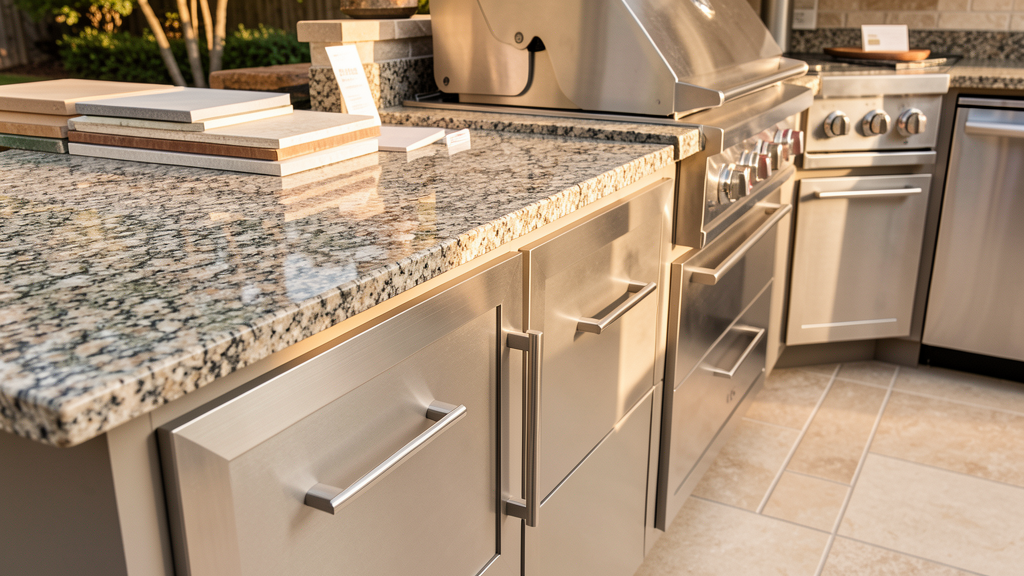
Outdoor Kitchen Materials Guide: What to Use and What to Avoid
Choosing the right materials for your outdoor kitchen determines its durability, appearance, and maintenance requirements. The wrong materials crack, rust, warp, or fade within months. The right materials withstand decades of weather, use, and temperature swings.
This comprehensive guide covers every material you’ll encounter when building an outdoor kitchen — from countertops and cabinets to flooring and roofing. We’ll explain what works, what fails, and why climate matters more than aesthetics.
The 4 Key Properties of Outdoor Materials
Before diving into specific materials, understand what makes a material suitable for outdoor use:
1. Weather Resistance
Outdoor materials must withstand:
– Rain and moisture — prevents rot, rust, and mold
– UV radiation — prevents fading and degradation
– Temperature swings — prevents cracking and warping
– Freeze-thaw cycles — prevents spalling and cracking
2. Durability
Outdoor kitchens get heavy use. Materials must resist:
– Impact — dropped pots, tools, and appliances
– Scratches — cutting, dragging, and cleaning
– Stains — food, grease, and chemicals
– Wear — foot traffic and daily use
3. Low Maintenance
Outdoor materials should require minimal upkeep:
– No sealing (or annual sealing at most)
– Easy cleaning — soap and water, no special products
– No painting — color should be integral, not surface-applied
– No treatments — no annual oils, waxes, or conditioners
4. Climate Adaptability
Different climates demand different materials:
– Coastal — salt resistance is critical
– Tropical — moisture and mold resistance
– Desert — UV and heat resistance
– Cold — freeze-thaw resistance
Countertop Materials: What Works and What Fails
Countertops are the most used surface in your outdoor kitchen. They must withstand heat, cuts, stains, and weather.
✅ Best: Granite
Why it works:
– Natural stone, extremely durable
– Heat resistant (can place hot pots directly on surface)
– Scratch resistant
– UV resistant (won’t fade)
– Available in many colors and patterns
Maintenance:
– Seal annually (or when water no longer beads)
– Clean with pH-neutral stone cleaner
– Avoid acidic cleaners (vinegar, lemon)
Budget: $60 – $100 per square foot (installed)
Best for: All climates, especially hot and sunny areas
✅ Best: Quartz
Why it works:
– Engineered stone (93% quartz, 7% resin)
– Non-porous (no sealing required)
– Stain resistant
– Scratch resistant
– Available in many colors and patterns
Maintenance:
– No sealing required
– Clean with mild soap and water
– Avoid harsh chemicals
Budget: $80 – $150 per square foot (installed)
Best for: All climates, especially areas with heavy use
Note: Some quartz brands are not UV stable — choose outdoor-rated quartz for sunny locations.
✅ Good: Porcelain Tile
Why it works:
– Extremely durable and dense
– Stain resistant
– Scratch resistant
– UV resistant
– Available in many styles (including stone and wood looks)
Maintenance:
– No sealing required
– Clean with mild soap and water
– Grout lines may require sealing
Budget: $40 – $70 per square foot (installed)
Best for: All climates, especially budget-conscious projects
✅ Good: Stainless Steel
Why it works:
– Extremely durable
– Heat resistant
– Non-porous (hygienic)
– Professional appearance
Maintenance:
– Clean with stainless steel cleaner
– Wipe with the grain to avoid scratches
– Avoid chlorine bleach
Budget: $70 – $120 per square foot (installed)
Best for: Professional or coastal kitchens
Note: Choose 304 grade stainless steel for best rust resistance.
❌ Avoid: Marble
Why it fails:
– Porous (stains easily)
– Soft (scratches and chips)
– Reacts with acids (lemon, vinegar, wine)
– Requires frequent sealing
Problem: Even with sealing, marble etches and stains quickly outdoors.
❌ Avoid: Laminate
Why it fails:
– Delaminates in heat and moisture
– Scratches easily
– Fades in UV light
– Not suitable for outdoor use
Problem: Laminate countertops fail within 1-2 years outdoors.
❌ Avoid: Concrete (Unsealed)
Why it fails:
– Porous (stains easily)
– Cracks in freeze-thaw cycles
– Requires frequent sealing
– Can harbor mold and bacteria
Problem: Unsealed concrete deteriorates quickly outdoors.
Exception: Sealed concrete can work, but requires annual maintenance.
Cabinet Materials: What Works and What Fails
Cabinets provide storage and define the look of your outdoor kitchen. They must withstand moisture, temperature swings, and UV exposure.
✅ Best: Aluminum
Why it works:
– Lightweight (easy to install)
– Rust-proof (ideal for coastal areas)
– UV resistant (won’t fade or crack)
– Low maintenance (no painting or sealing)
– Available in powder-coated finishes
Maintenance:
– Clean with mild soap and water
– No sealing or painting required
– Touch up scratches with matching paint
Budget: $1,500 – $7,500+ (depending on configuration)
Best for: All climates, especially coastal and humid areas
Recommended: Cubox OKC Series (OKC-005, OKC-006, OKC-007)
✅ Best: 304 Stainless Steel
Why it works:
– Extremely durable
– Rust resistant (better than 430 grade)
– Professional appearance
– Heat resistant
Maintenance:
– Clean with stainless steel cleaner
– Wipe with the grain
– Avoid chlorine bleach
Budget: $3,000 – $8,000+
Best for: Professional or coastal kitchens
Note: Choose 304 grade over 430 grade for better rust resistance.
✅ Good: Powder-Coated Steel
Why it works:
– Durable steel construction
– Powder coating provides UV and moisture resistance
– More affordable than stainless steel
Maintenance:
– Clean with mild soap and water
– Touch up scratches to prevent rust
Budget: $1,200 – $4,000
Best for: Budget-conscious projects in dry climates
Note: Not recommended for coastal or humid areas (powder coating can chip, leading to rust).
❌ Avoid: Wood
Why it fails:
– Rot in moisture
– Warp in temperature swings
– Requires annual sealing or oiling
– Attracts insects and pests
Problem: Wood cabinets deteriorate quickly outdoors, even with maintenance.
Exception: Teak or marine-grade plywood can work in covered, dry areas, but still requires maintenance.
❌ Avoid: MDF or Particleboard
Why it fails:
– Swells and disintegrates in moisture
– Not suitable for outdoor use
– Falls apart within months
Problem: MDF and particleboard are indoor materials — they fail immediately outdoors.
Flooring Materials: What Works and What Fails
Flooring must withstand foot traffic, weather, and spills. It should be slip-resistant and easy to clean.
✅ Best: Porcelain Tile
Why it works:
– Extremely durable
– Slip resistant (choose textured finish)
– Stain resistant
– UV resistant
– Available in many styles
Maintenance:
– Sweep and mop regularly
– Seal grout lines annually
– Clean with mild soap and water
Budget: $8 – $15 per square foot (installed)
Best for: All climates
✅ Best: Natural Stone (Granite, Slate, Bluestone)
Why it works:
– Extremely durable
– Natural beauty
– Slip resistant (choose textured finish)
– UV resistant
Maintenance:
– Seal annually
– Sweep and mop regularly
– Clean with pH-neutral stone cleaner
Budget: $15 – $30 per square foot (installed)
Best for: All climates, especially luxury installations
✅ Good: Concrete (Sealed)
Why it works:
– Durable and long-lasting
– Can be stained or stamped for decorative effects
– Slip resistant (when textured)
Maintenance:
– Seal annually
– Sweep and mop regularly
– Clean with mild soap and water
Budget: $8 – $12 per square foot (installed)
Best for: Dry climates
Note: Requires annual sealing to prevent stains and cracking.
✅ Good: Composite Decking
Why it works:
– Durable and low maintenance
– Slip resistant
– Available in many colors and textures
– No sealing required
Maintenance:
– Sweep and mop regularly
– Clean with composite deck cleaner
Budget: $10 – $20 per square foot (installed)
Best for: Covered patios and decks
Note: Not recommended for fully exposed areas (can fade in UV).
❌ Avoid: Indoor Tile
Why it fails:
– Not frost resistant (cracks in freeze-thaw cycles)
– Not slip resistant
– Not UV stable
Problem: Indoor tiles crack and become slippery outdoors.
❌ Avoid: Hardwood Flooring
Why it fails:
– Rot in moisture
– Warp in temperature swings
– Requires annual sealing
– Becomes slippery when wet
Problem: Hardwood flooring deteriorates quickly outdoors.
Pergola and Roofing Materials: What Works and What Fails
If your outdoor kitchen is covered, the roofing material must withstand weather while providing shade and protection.
✅ Best: Aluminum Pergola
Why it works:
– Lightweight and durable
– Rust proof
– UV resistant
– Low maintenance
– Available with adjustable louvers
Maintenance:
– Clean with mild soap and water
– No painting or sealing required
Budget: $3,000 – $8,000+
Best for: All climates
Recommended: Cubox OKM Series Pergola
✅ Best: Polycarbonate Roofing
Why it works:
– Lightweight and durable
– UV resistant (choose UV-protected grades)
– Translucent (allows light through)
– Impact resistant
Maintenance:
– Clean with mild soap and water
– Inspect seals annually
Budget: $5 – $12 per square foot (installed)
Best for: All climates
✅ Good: Wood Pergola (Cedar, Redwood)
Why it works:
– Natural beauty
– Durable (if properly maintained)
– Can be stained or painted
Maintenance:
– Seal or stain annually
– Inspect for rot and insects
– Clean with mild soap and water
Budget: $4,000 – $10,000+
Best for: Dry climates
Note: Requires annual maintenance to prevent rot and insect damage.
❌ Avoid: Asphalt Shingles
Why it fails:
– Not suitable for pergolas or open structures
– Degrades in UV light
– Not aesthetically appropriate
Problem: Asphalt shingles are for enclosed roofs, not outdoor kitchen pergolas.
Appliance Materials: What Works and What Fails
Appliances must be rated for outdoor use. Indoor appliances fail quickly outdoors.
✅ Best: 304 Stainless Steel
Why it works:
– Rust resistant
– Durable
– Professional appearance
– Heat resistant
Maintenance:
– Clean with stainless steel cleaner
– Wipe with the grain
– Avoid chlorine bleach
Best for: All climates, especially coastal areas
✅ Good: Powder-Coated Aluminum
Why it works:
– Lightweight
– Rust proof
– UV resistant
Maintenance:
– Clean with mild soap and water
– Touch up scratches
Best for: All climates
❌ Avoid: Indoor Appliances
Why they fail:
– Not rated for outdoor temperatures
– Not UV resistant
– Not moisture resistant
– Void warranty when used outdoors
Problem: Indoor appliances fail within months outdoors.
Rule: Always choose appliances rated for outdoor use.
Climate-Specific Material Recommendations
Different climates demand different materials. Here’s what to choose:
Coastal/Saltwater Environments
Priority: Salt resistance
Recommended:
– Cabinets: Aluminum (Cubox OKC Series) or 304 stainless steel
– Countertops: Granite, quartz, or stainless steel
– Flooring: Porcelain tile or natural stone
– Pergola: Aluminum with adjustable louvers
Avoid:
– Steel (even powder-coated)
– Wood
– Cast iron
Tropical/Humid Climates
Priority: Moisture and mold resistance
Recommended:
– Cabinets: Aluminum or stainless steel
– Countertops: Quartz, granite, or porcelain tile
– Flooring: Porcelain tile or natural stone
– Pergola: Aluminum or polycarbonate
Avoid:
– Wood
– MDF or particleboard
– Unsealed concrete
Desert/Arid Climates
Priority: UV and heat resistance
Recommended:
– Cabinets: Aluminum with UV-stable powder coating
– Countertops: Granite, quartz (outdoor-rated), or porcelain tile
– Flooring: Porcelain tile, natural stone, or sealed concrete
– Pergola: Aluminum or polycarbonate with UV protection
Avoid:
– Dark-colored materials (absorb heat)
– Plastic components (become brittle)
– Wood (dries out and cracks)
Cold/Snowy Climates
Priority: Freeze-thaw resistance
Recommended:
– Cabinets: Aluminum or stainless steel
– Countertops: Granite, quartz, or porcelain tile
– Flooring: Porcelain tile, natural stone, or sealed concrete (frost-rated)
– Pergola: Aluminum or wood (cedar, redwood)
Avoid:
– Unsealed concrete (cracks in freeze-thaw)
– Indoor-rated tiles (not frost resistant)
– Materials that absorb moisture
Budget Breakdown: Material Costs by Category
Here’s what to expect for materials in a typical outdoor kitchen:
Budget-Friendly Setup ($5,000 – $8,000)
- Cabinets: Powder-coated steel ($1,200 – $2,500)
- Countertops: Porcelain tile ($600 – $1,000)
- Flooring: Porcelain tile ($400 – $750)
- Pergola: Basic aluminum ($2,000 – $3,500)
Total: $4,200 – $7,750
Mid-Range Setup ($10,000 – $15,000)
- Cabinets: Aluminum (Cubox OKC-006) ($3,000 – $4,500)
- Countertops: Granite ($1,500 – $2,500)
- Flooring: Natural stone ($1,500 – $2,250)
- Pergola: Aluminum with louvers ($4,000 – $5,500)
Total: $10,000 – $14,750
Premium Setup ($20,000 – $30,000)
- Cabinets: Aluminum (Cubox OKC-007) ($6,000 – $7,500)
- Countertops: Quartz ($2,000 – $3,750)
- Flooring: Natural stone ($3,000 – $4,500)
- Pergola: Premium aluminum with integrated lighting ($8,000 – $12,000)
Total: $19,000 – $27,750
Common Material Mistakes to Avoid
Mistake 1: Choosing Aesthetics Over Durability
Problem: Beautiful materials that fail quickly outdoors.
Solution: Prioritize outdoor-rated materials, then choose colors and finishes.
Mistake 2: Ignoring Climate
Problem: Materials that work in one climate fail in another.
Solution: Choose materials rated for your specific climate conditions.
Mistake 3: Skipping Maintenance Requirements
Problem: Materials that require more maintenance than you’re willing to do.
Solution: Be honest about maintenance. Choose low-maintenance materials if you don’t want annual sealing or cleaning.
Mistake 4: Using Indoor Materials Outdoors
Problem: Indoor materials fail quickly when exposed to weather.
Solution: Always choose materials rated for outdoor use.
Mistake 5: Prioritizing Cost Over Quality
Problem: Cheap materials that need replacement in 2-3 years.
Solution: Invest in quality materials that last 10-20 years. The total cost of ownership is lower.
Frequently Asked Questions
What’s the best material for outdoor kitchen cabinets?
Aluminum is the best choice for most climates because it’s:
– Lightweight and easy to install
– Rust proof (ideal for coastal areas)
– UV resistant (won’t fade or crack)
– Low maintenance (no painting or sealing)
304 stainless steel is ideal for professional or coastal applications where maximum durability is required.
Do I need to seal granite countertops?
Yes. Granite should be sealed annually (or when water no longer beads on the surface). Sealing prevents stains and extends the life of the countertop.
Can I use wood for my outdoor kitchen?
Not recommended. Wood rot, warp, and attract insects outdoors. If you must use wood, choose teak or marine-grade plywood, and seal it annually. Even then, expect 5-10 years of life (vs. 20-30 years for aluminum).
What’s the most durable outdoor countertop?
Granite and quartz are the most durable options. Both resist heat, scratches, and stains. Quartz requires no sealing, while granite needs annual sealing.
How do I prevent rust on stainless steel?
- Choose 304 grade (not 430 grade)
- Clean regularly with stainless steel cleaner
- Avoid chlorine bleach
- Rinse with fresh water after exposure to salt (coastal areas)
- Apply a protective wax or sealant annually
What’s the best flooring for an outdoor kitchen?
Porcelain tile is the best choice because it’s:
– Durable and slip resistant
– Stain resistant
– UV resistant
– Available in many styles
– Budget-friendly ($8 – $15 per square foot)
Conclusion: Choose Materials That Last
The right materials make your outdoor kitchen durable, beautiful, and low-maintenance. Prioritize weather resistance, durability, and climate adaptability over aesthetics alone.
Key takeaways:
1. Choose outdoor-rated materials for every component
2. Prioritize aluminum or stainless steel for cabinets
3. Select granite, quartz, or porcelain tile for countertops
4. Match materials to your specific climate
5. Invest in quality — cheap materials cost more in the long run
Ready to build your outdoor kitchen? Explore the Cubox Outdoor Kitchen Collection for durable, weather-resistant cabinets designed for every climate.
Request a free consultation to discuss material options with our design team.
Talk to Our Outdoor Kitchen Cabinet Team
Send Your Outdoor Kitchen Project Details
Use this area for cabinet layout questions, covered or modular direction, project coordination, and quote preparation.