

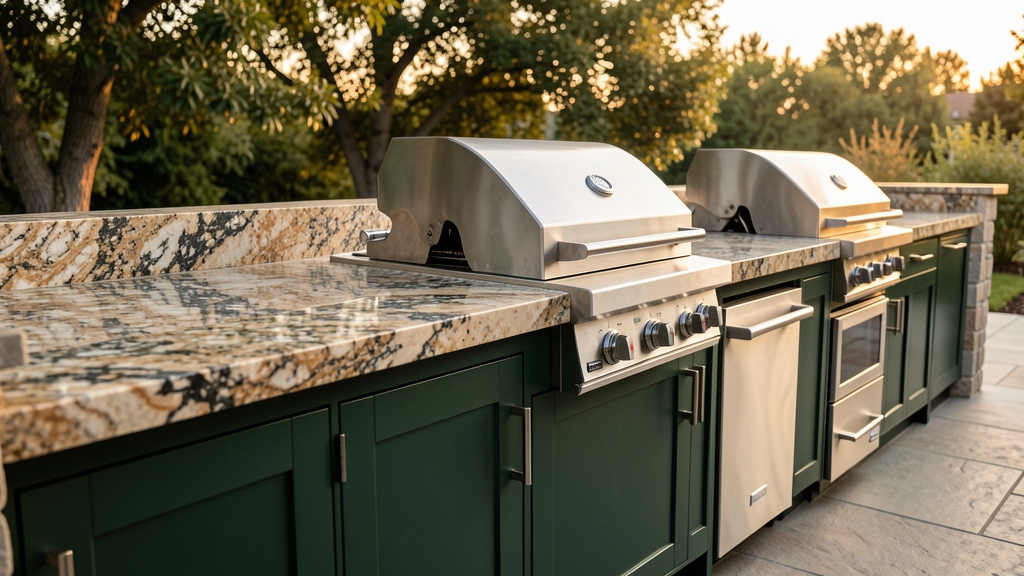
Outdoor Kitchen Countertop Guide: Best Materials for Durability and Style
Your outdoor kitchen countertop is the primary work surface for food preparation, serving, and entertaining. Unlike indoor countertops, outdoor surfaces face extreme challenges: intense UV radiation, freezing temperatures, rain, snow, grease splatters, and heavy use. Choose the wrong material, and you’ll deal with cracking, fading, staining, or deterioration within a few years.
This comprehensive guide covers outdoor kitchen countertops — from the most durable materials to installation tips and maintenance — so you can choose a surface that performs beautifully for decades.
What Makes a Good Outdoor Countertop?
Outdoor countertops must meet five critical requirements:
1. UV Resistance
Why it matters: Direct sunlight breaks down many materials, causing fading, discoloration, or degradation.
What to look for:
– UV-stable materials (won’t fade or yellow)
– Color that runs through the entire material (not just surface coating)
– Manufacturer’s UV warranty
2. Freeze-Thaw Resistance
Why it matters: Water seeps into porous materials, freezes, expands, and causes cracking.
What to look for:
– Low water absorption (less than 3%)
– Frost-resistant rating
– Dense, non-porous structure
3. Heat Resistance
Why it matters: Hot pots, pans, and grill tools can damage surfaces not designed for high temperatures.
What to look for:
– Withstands temperatures of 400°F+ without damage
– No melting, scorching, or discoloration
– Thermal shock resistance
4. Stain Resistance
Why it matters: Outdoor cooking involves wine, oil, tomato sauce, and other staining substances.
What to look for:
– Low porosity (doesn’t absorb liquids)
– Easy to clean
– Sealing requirements (minimal preferred)
5. Durability
Why it matters: Outdoor countertops see heavy use — cutting, dragging appliances, impact from dropped items.
What to look for:
– Scratch resistance
– Impact resistance
– Chip resistance
– Long lifespan (20+ years)
Best Outdoor Countertop Materials
✅ Granite: The Gold Standard
Why it works:
– Extremely durable (Mohs hardness 6-7)
– UV stable (won’t fade in sunlight)
– Frost resistant (withstands freeze-thaw cycles)
– Heat resistant (can place hot pots directly)
– Scratch and chip resistant
– Available in many colors and patterns
Maintenance:
– Seal annually (or when water no longer beads)
– Clean with pH-neutral stone cleaner
– Avoid acidic cleaners (vinegar, lemon)
– Wipe up spills promptly
Budget: $60 – $150 per square foot (installed)
Best for: All climates, high-use outdoor kitchens, luxury installations
Pros:
– Natural beauty (unique patterns)
– Adds value to your home
– 20-50+ year lifespan
– Withstands extreme weather
Cons:
– Requires annual sealing
– Heavy (requires strong cabinet support)
– Can crack if improperly installed
– Expensive
Installation tips:
– Use exterior-grade plywood substrate
– Ensure cabinets can support weight (15-20 lbs per square foot)
– Leave expansion joints
– Hire professional fabricator and installer
– Seal before and after installation
✅ Quartzite: Premium Performance
Why it works:
– Harder than granite (Mohs 7-8)
– UV stable
– Frost resistant
– Heat resistant
– Extremely scratch resistant
– Beautiful natural appearance (marble-like)
Maintenance:
– Seal annually (more frequently than granite)
– Clean with pH-neutral stone cleaner
– Avoid acidic cleaners
Budget: $80 – $180 per square foot (installed)
Best for: Luxury outdoor kitchens, high-use areas, hot climates
Pros:
– Harder and more durable than granite
– Beautiful marble-like appearance
– 20-50+ year lifespan
– UV and frost resistant
Cons:
– More expensive than granite
– Requires more frequent sealing
– Heavy (requires strong support)
– Limited availability
Installation tips:
– Same as granite (professional installation required)
– Ensure proper support (heavier than granite)
– Seal thoroughly before use
✅ Porcelain Slabs: Modern and Low-Maintenance
Why it works:
– Extremely durable (PEI rating 5)
– UV stable (color runs through entire slab)
– Frost resistant (less than 0.5% water absorption)
– Heat resistant (can withstand 1000°F+)
– Scratch and stain resistant
– Non-porous (no sealing required)
Maintenance:
– No sealing required
– Clean with mild detergent
– Wipe up spills (though staining is rare)
– Avoid abrasive cleaners
Budget: $70 – $160 per square foot (installed)
Best for: Modern designs, low-maintenance requirements, all climates
Pros:
– Zero maintenance (no sealing)
– Extremely durable
– Available in many styles (stone, concrete, wood looks)
– Thin profile (lighter than stone)
– 20-50+ year lifespan
Cons:
– Expensive
– Requires professional fabrication
– Can chip on edges (if impacted)
– Limited edge profile options
Installation tips:
– Use exterior-grade substrate
– Professional fabrication and installation required
– Use thinset mortar rated for porcelain
– Leave expansion joints
– Handle with care (thin slabs can crack during installation)
✅ Sintered Stone: Next-Generation Performance
Why it works:
– Ultra-compressed mineral materials
– UV stable
– Frost resistant
– Heat resistant (withstands 1000°F+)
– Scratch, stain, and impact resistant
– Non-porous (no sealing required)
– Hygienic (bacteria-resistant)
Maintenance:
– No sealing required
– Clean with mild detergent
– Wipe up spills
– Avoid abrasive cleaners
Budget: $90 – $200 per square foot (installed)
Best for: High-end outdoor kitchens, maximum durability, modern designs
Pros:
– Superior performance (harder than granite)
– Zero maintenance
– Available in many styles
– Thin profile (lighter than stone)
– 30-50+ year lifespan
– Hygienic surface
Cons:
– Most expensive option
– Requires professional fabrication
– Limited availability
– Can chip on edges
Recommended brands:
– Dekton (Cosentino)
– Neolith
– Lapitec
Installation tips:
– Professional fabrication and installation required
– Use exterior-grade substrate
– Follow manufacturer specifications
– Leave expansion joints
✅ Concrete: Versatile and Customizable
Why it works:
– Extremely durable (when properly sealed)
– Can be customized (color, texture, embedded items)
– UV stable (with UV-stable pigments)
– Frost resistant (when properly mixed and sealed)
– Heat resistant
– Seamless appearance
Maintenance:
– Seal annually (or every 2-3 years)
– Clean with pH-neutral cleaner
– Avoid acidic cleaners
– Repair cracks promptly
Budget: $65 – $130 per square foot (installed)
Best for: Custom designs, modern aesthetics, budget-conscious luxury
Pros:
– Fully customizable (color, texture, shape)
– Seamless appearance
– Can embed objects (glass, stone, metal)
– 20-40 year lifespan
– Integrally colored (won’t fade)
Cons:
– Requires annual sealing
– Can crack (control joints required)
– Heavy (requires strong support)
– Stains if not sealed properly
– Requires professional installation
Installation tips:
– Use exterior-grade concrete mix
– Add fiber reinforcement (prevents cracking)
– Install control joints (every 4-6 feet)
– Seal thoroughly before use
– Professional installation recommended
✅ Tile: Budget-Friendly and Versatile
Why it works:
– Affordable
– Available in many styles
– UV stable (porcelain tile)
– Frost resistant (outdoor-rated tile)
– Heat resistant
– Easy to replace individual tiles
Maintenance:
– Seal grout lines annually
– Clean with mild detergent
– Replace cracked or damaged tiles
– Avoid acidic cleaners on natural stone tile
Budget: $30 – $80 per square foot (installed)
Best for: Budget projects, DIY installation, warm climates
Pros:
– Affordable
– Wide variety of styles
– Easy to repair (replace individual tiles)
– DIY-friendly (for experienced tilers)
– 15-30 year lifespan
Cons:
– Grout lines collect dirt and stains
– Can crack (if substrate moves)
– Requires annual grout sealing
– Uneven surface (grout lines)
– Less durable than solid surfaces
Installation tips:
– Use outdoor-rated porcelain tile
– Install over concrete slab or exterior-grade plywood
– Use exterior-grade thinset mortar
– Leave expansion joints
– Seal grout lines annually
Materials to Avoid
❌ Marble
Why it fails:
– Soft and porous (Mohs 3-4)
– Stains easily (wine, oil, acidic foods)
– Etches from acidic substances (lemon, vinegar)
– Not UV stable (can yellow)
– Requires frequent sealing
Problem: Marble is beautiful but impractical for outdoor use. It stains, etches, and deteriorates quickly.
❌ Laminate
Why it fails:
– Not UV stable (fades and yellows)
– Not heat resistant (melts or scorches)
– Absorbs moisture (swells and delaminates)
– Not durable (scratches and chips easily)
– Short lifespan outdoors (2-5 years)
Problem: Laminate is an indoor-only material. It will fail quickly in outdoor conditions.
❌ Wood (Butcher Block)
Why it fails:
– Rot in moisture
– Warp in temperature swings
– Requires monthly sealing
– Stains easily
– Attracts insects
– Short lifespan outdoors (3-7 years)
Problem: Wood is not suitable for outdoor countertops, even in covered areas. It deteriorates quickly and requires constant maintenance.
Exception: Tropical hardwoods like Ipe or Teak can work in covered, dry areas, but still require monthly maintenance and have limited lifespan.
❌ Solid Surface (Corian)
Why it fails:
– Not UV stable (fades and yellows)
– Not heat resistant (scorches at 350°F+)
– Scratches easily
– Expensive
– Not designed for outdoor use
Problem: Solid surface materials are designed for indoor use. They fade, scratch, and heat-damage quickly outdoors.
Climate-Specific Countertop Recommendations
Coastal/Saltwater Environments
Priority: Salt resistance, UV stability
Recommended:
– Granite (dense varieties)
– Porcelain slabs
– Sintered stone
Avoid:
– Concrete (salt can cause spalling)
– Tile (grout can deteriorate)
Tropical/Humid Climates
Priority: Moisture resistance, mold resistance
Recommended:
– Porcelain slabs (non-porous)
– Sintered stone (non-porous)
– Granite (when properly sealed)
Avoid:
– Concrete (absorbs moisture)
– Wood (rots in humidity)
Desert/Arid Climates
Priority: Heat resistance, UV stability
Recommended:
– Granite (light colors reflect heat)
– Porcelain slabs (light colors)
– Sintered stone (light colors)
– Concrete (integrally colored)
Avoid:
– Dark-colored materials (absorb heat)
– Wood (dries out and cracks)
Cold/Snowy Climates
Priority: Frost resistance, freeze-thaw durability
Recommended:
– Granite (frost-resistant varieties)
– Porcelain slabs (frost-resistant)
– Quartzite (frost-resistant)
– Sintered stone (frost-resistant)
Avoid:
– Indoor-rated tile (not frost-resistant)
– Concrete (can crack if not properly mixed)
Countertop Edge Profiles
Straight Edge (Square)
Description: Simple, clean 90-degree edge
Best for: Modern designs, porcelain slabs, sintered stone
Pros:
– Easy to clean
– Minimal chipping risk
– Contemporary appearance
Cons:
– Sharp edge (can be uncomfortable)
– Less decorative
Beveled Edge
Description: 45-degree angle cut on top edge
Best for: Traditional designs, granite, quartzite
Pros:
– Comfortable to lean against
– Reduces chipping risk
– Classic appearance
Cons:
– Slightly harder to clean
– Less modern
Bullnose Edge
Description: Fully rounded edge
Best for: Family-friendly designs, all materials
Pros:
– Safe (no sharp edges)
– Comfortable
– Reduces chipping risk
Cons:
– Less decorative
– Harder to fabricate on some materials
Ogee Edge
Description: S-curve profile (decorative)
Best for: Luxury installations, granite, quartzite
Pros:
– Elegant, decorative appearance
– Adds value
– Traditional look
Cons:
– Expensive to fabricate
– Can chip on sharp points
– Harder to clean
Waterfall Edge
Description: Countertop continues down side of cabinet
Best for: Modern designs, islands, peninsulas
Pros:
– Sleek, contemporary appearance
– Protects cabinet sides
– Adds visual interest
Cons:
– Expensive (more material required)
– Complex fabrication
– Not suitable for all designs
Installation: Substrate and Support
Substrate Requirements
For stone and porcelain:
– 3/4″ exterior-grade plywood (minimum)
– Cement backer board (recommended)
– Uncoupling membrane (prevents cracking)
For concrete:
– Concrete slab (ideal)
– 3/4″ exterior-grade plywood with cement backer board
– Steel or concrete supports
For tile:
– Concrete slab (ideal)
– 3/4″ exterior-grade plywood with cement backer board
Support Requirements
Weight considerations:
– Granite: 15-20 lbs per square foot
– Quartzite: 15-20 lbs per square foot
– Porcelain: 8-12 lbs per square foot
– Sintered stone: 8-12 lbs per square foot
– Concrete: 20-25 lbs per square foot
– Tile: 10-15 lbs per square foot
Cabinet requirements:
– Ensure cabinets can support weight
– Reinforce as needed (additional supports, brackets)
– Distribute weight evenly
– Anchor cabinets to foundation
Expansion Joints
Why they matter:
– Materials expand and contract with temperature
– Prevents cracking and buckling
– Required by building codes
Where to install:
– Every 10-12 feet (for long runs)
– At corners and changes in direction
– Around sinks and cooktops
– Between countertop and backsplash
How to install:
– Leave 1/8″ gap
– Fill with flexible caulk (color-matched)
– Use backer rod for deep gaps
Maintenance: Keep Your Countertop Looking Great
Daily Maintenance
- Wipe up spills promptly
- Clean with mild detergent and soft cloth
- Avoid abrasive cleaners or scrubbers
- Use cutting boards (protects surface)
- Use trivets for hot pots (even on heat-resistant surfaces)
Weekly Maintenance
- Deep clean with pH-neutral cleaner
- Inspect for damage or wear
- Clean grout lines (if applicable)
- Check sealant (if applicable)
Seasonal Maintenance
- Inspect sealant (reapply if water no longer beads)
- Deep clean with appropriate cleaner
- Inspect for cracks or damage
- Repair damage promptly
Annual Maintenance
- Seal stone and concrete (annually or as needed)
- Deep clean and inspect
- Repair any damage
- Re-caulk expansion joints if needed
Common Countertop Problems and Solutions
Problem 1: Cracking
Causes:
– Improper installation (insufficient support)
– Substrate movement (settling, temperature)
– Impact damage
– No expansion joints
Solutions:
– Ensure proper support and substrate
– Install expansion joints
– Use crack isolation membrane
– Repair cracks with epoxy filler (stone) or concrete patch
Problem 2: Staining
Causes:
– Spills (wine, oil, acidic foods)
– Unsealed or poorly sealed surface
– Porous material
Solutions:
– Clean spills promptly
– Seal surface annually (stone, concrete)
– Use poultice cleaner for stubborn stains
– Choose non-porous materials (porcelain, sintered stone)
Problem 3: Etching (Dull Spots)
Causes:
– Acidic substances (lemon, vinegar, tomato)
– Harsh cleaners
– Marble or limestone (soft stone)
Solutions:
– Avoid acidic substances on stone
– Use pH-neutral cleaners
– Polish etched areas (professional restoration)
– Choose etch-resistant materials (granite, porcelain, sintered stone)
Problem 4: Chipping
Causes:
– Impact from heavy objects
– Sharp edges (ogee profile)
– Dropping pots or tools
Solutions:
– Use rounded edge profiles (bullnose, beveled)
– Avoid dropping heavy objects
– Repair chips with epoxy filler (stone) or concrete patch
– Choose chip-resistant materials (porcelain, sintered stone)
Problem 5: Fading or Discoloration
Causes:
– UV exposure (non-UV-stable materials)
– Harsh cleaners
– Chemical reactions
Solutions:
– Choose UV-stable materials (granite, porcelain, sintered stone)
– Use UV-stable sealers
– Avoid harsh chemicals
– Replace faded materials
Budget Breakdown: Countertop Costs
Budget-Friendly ($30 – $80 per square foot)
- Porcelain tile
- Basic granite (limited colors)
- Concrete (basic finish)
Total cost (30 sq ft): $900 – $2,400
Mid-Range ($80 – $150 per square foot)
- Premium granite
- Porcelain slabs
- Concrete (decorative finish)
Total cost (30 sq ft): $2,400 – $4,500
Premium ($150 – $200+ per square foot)
- Quartzite
- Sintered stone (Dekton, Neolith)
- Custom concrete (embedded objects)
Total cost (30 sq ft): $4,500 – $6,000+
Frequently Asked Questions
What’s the best countertop for an outdoor kitchen?
Granite is the best overall choice because it’s:
– Extremely durable
– UV stable
– Frost resistant
– Heat resistant
– Beautiful and adds value
Porcelain slabs are best for low-maintenance requirements, while sintered stone offers the highest performance (at a premium price).
Can I use indoor countertops outdoors?
No. Indoor countertops (laminate, solid surface, marble) are not UV stable, not frost resistant, and not designed for outdoor conditions. They will fade, crack, or deteriorate quickly.
Always choose materials rated for outdoor use.
Do I need to seal my outdoor countertop?
It depends on the material:
– Granite: Yes (annually)
– Quartzite: Yes (annually, more frequently than granite)
– Porcelain: No (non-porous)
– Sintered stone: No (non-porous)
– Concrete: Yes (annually or every 2-3 years)
– Tile: Yes (grout lines annually)
How much does an outdoor kitchen countertop cost?
Budget setup: $900 – $2,400 (30 sq ft)
– Porcelain tile or basic granite
Mid-range setup: $2,400 – $4,500 (30 sq ft)
– Premium granite or porcelain slabs
Premium setup: $4,500 – $6,000+ (30 sq ft)
– Quartzite or sintered stone
Can I install outdoor countertops myself?
DIY-friendly:
– Tile (if you have tiling experience)
– Concrete (if you have concrete experience)
Professional recommended:
– Granite, quartzite (heavy, requires fabrication)
– Porcelain slabs (requires specialized tools)
– Sintered stone (requires specialized fabrication)
How long do outdoor countertops last?
With proper installation and maintenance:
– Granite: 20-50+ years
– Quartzite: 20-50+ years
– Porcelain: 20-50+ years
– Sintered stone: 30-50+ years
– Concrete: 20-40 years
– Tile: 15-30 years
What’s the most low-maintenance outdoor countertop?
Sintered stone (Dekton, Neolith) and porcelain slabs are the most low-maintenance options:
– No sealing required
– Stain resistant
– UV stable
– Easy to clean
– 20-50+ year lifespan
Conclusion: Choose a Countertop That Lasts
The right countertop makes your outdoor kitchen functional, beautiful, and durable. Prioritize UV resistance, frost resistance, and durability over aesthetics alone.
Key takeaways:
1. Choose outdoor-rated materials for every application
2. Granite offers the best balance of performance and beauty
3. Porcelain and sintered stone offer zero-maintenance performance
4. Seal stone and concrete annually
5. Invest in professional installation for stone and porcelain
Ready to upgrade your outdoor kitchen countertop? Explore the Cubox Outdoor Kitchen Collection for durable, weather-resistant cabinets that support any countertop choice.
Request a free consultation to discuss countertop options with our design team.